
Houston Remains Preferred Premier, Liberal Brand Ascendant
A possible “Mark Carney effect” may be propelling the permanent-leaderless Liberals to second place in party preference while premier Houston outperforms his PC Party
Halifax, NS – As Nova Scotia’s majority Progressive Conservative government nears the halfway point of its current mandate, a strong federal Liberal brand appears to be casting a halo effect on its provincial counterpart in Nova Scotia. While the PC Party maintains an edge among decided and leaning voters (38%), the Liberal Party (34%) has traded places with the NDP (22%) in a reversal of the 2024 provincial election result, according to a new poll by MQO Research. The Green Party earned four percent. Responses were collected July 3 – 9, 2026 via mixed-mode online and live-interviewer telephone survey, with a sample size of 632 eligible voters (Canadian citizens residing in Nova Scotia).
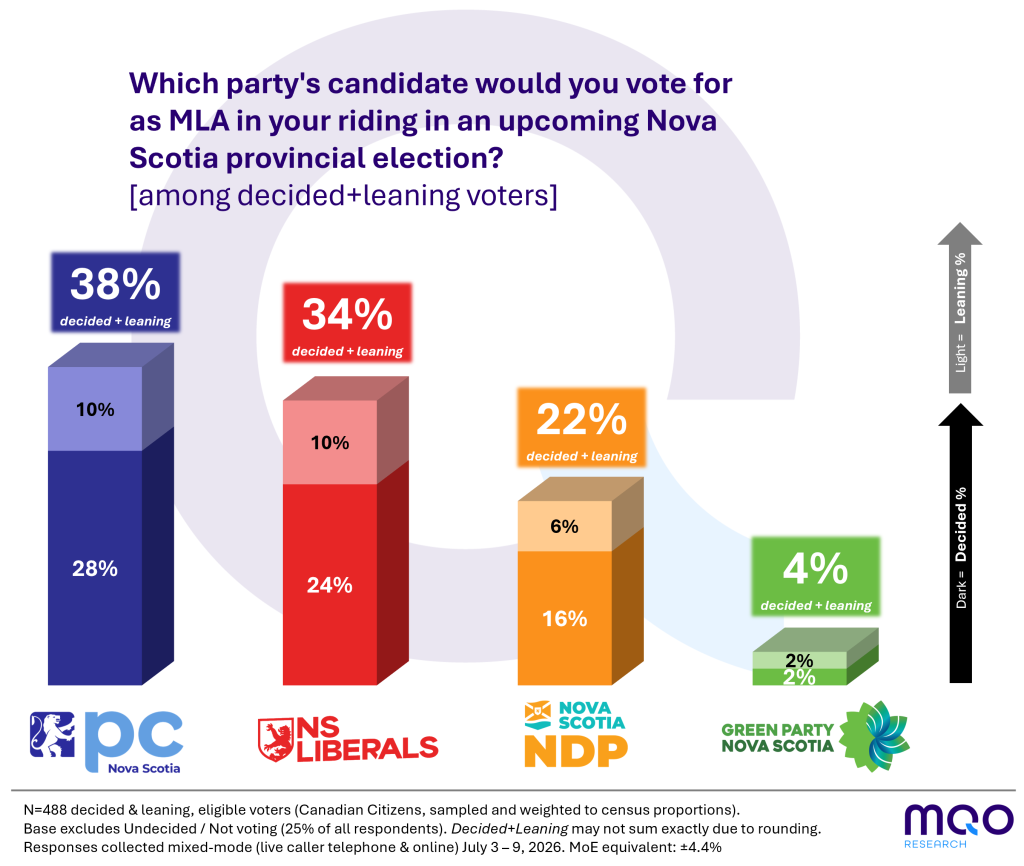
The PC Party continues to be dominant in rural areas (47%, vs Liberals: 36%; NDP: 12%) and maintains an edge in suburban areas of the province (35%), where there is a dogfight for second place between the Liberals (30%) and the NDP (29%). The NDP are in second place only in HRM (32%, vs PCs: 36%; Liberals: 27%). In the rest of the province, the Liberals (41%) and PCs (39%) are statistically tied for first, with the NDP (13%) trailing significantly.
Demographically, the PC Party is the most preferred party among males (46%, vs Liberals: 30%; NDP: 22%) and those aged 60 years and younger. The Liberal Party is most preferred among females (38%, vs PC: 30%; NDP: 23%) and those aged 61 and older. The NDP are tied for the top spot with the PCs among Gen Z (aged 18-29) at 36% support each, while the Liberals earn 26% among that age cohort.
| HRM Overall: | PC 36% | NDP 32% | Liberal 27% |
| HRM Urban: | PC 36% | NDP 32% | Liberal 30% |
| HRM Suburban: | PC 36% | NDP 34% | Liberal 22% |
| Rest of NS: | Liberal 41% | PC 39% | NDP 13% |
| Males: | PC 46% | Liberal 30% | NDP 22% |
| Females: | Liberal 38% | PC 30% | NDP 23% |
| Gen Z (18-29): | PC 36% | NDP 36% | Liberal 26% |
| Millennials (30-45): | PC 35% | Liberal 31% | NDP 23% |
| Gen X (46-60): | PC 44% | Liberal 28% | NDP 21% |
| Gen Jones (61-72): | Liberal 44% | PC 37% | NDP 17% |
| Boomers+ (73+): | Liberal 47% | PC 35% | NDP 17% |
Houston and Chender running ahead of their parties, interim leader Rankin running behind
As with the PC Party he leads, Tim Houston remains in first place as preferred premier among decided voters (44%), with a statistical tie for second place between interim Liberal leader Iain Rankin (27%) and NDP leader Claudia Chender (26%). Support for Houston and Chender run ahead of their parties by six and four percentage points respectively, while support for Rankin trails support for his Liberals by seven percentage points. These results suggest that if an election were held today, the Liberals’ choice for permanent leader would be a major factor in the outcome.
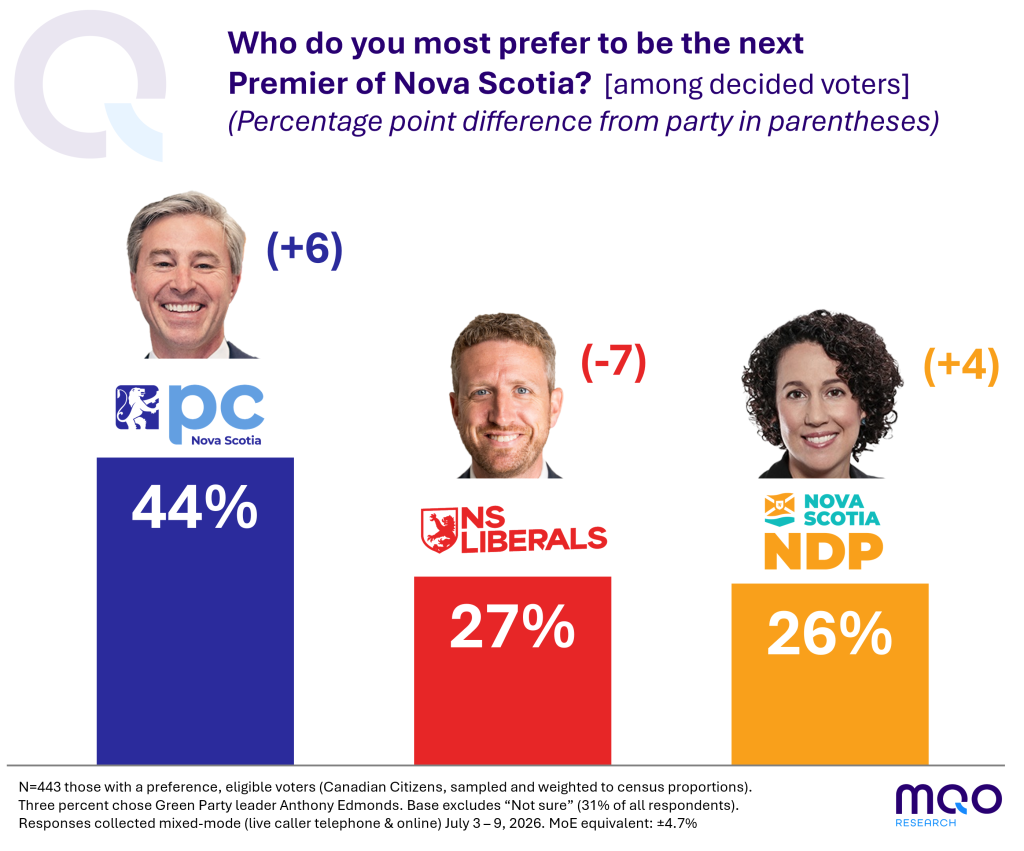
“Premier Tim Houston continues to garner the most confidence as preferred premier among the options available to Nova Scotians today,” said Brenden Sommerhalder, president of MQO Research.
“With somewhat softening support for the current governing party compared to the 2024 election result and extremely strong support for the federal Liberals led by prime minister Mark Carney evident in national polling, without an imminent provincial election, some Nova Scotians appear open to parking their voting intentions with the provincial party while they wait to see who the Liberal leader will be and how they will position themselves in a future election.”
Government approval strongest on economic growth issues, weakest on affordability
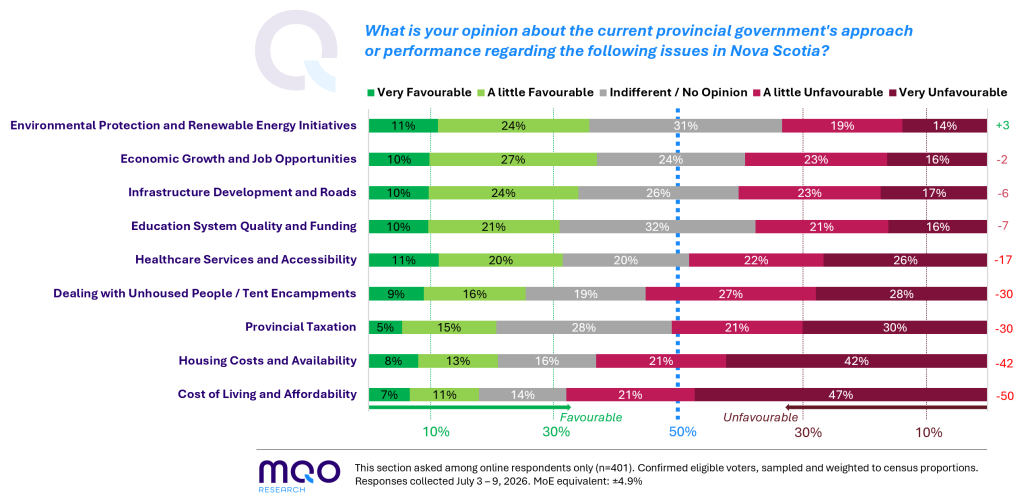
The latest MQO poll found that a greater proportion of Nova Scotians are dissatisfied with the current provincial government (47%) than are satisfied (33%), with a net satisfaction rating of -14%. Twenty percent of respondents were indifferent or had no opinion.
In an open-ended question about the concerns affecting their everyday lives, an overwhelming majority of Nova Scotians mentioned issues related to cost of living and personal finances (72%).
“Nova Scotians’ acute focus on their pocketbooks seems to be a leading cause for a softening of satisfaction with the governing PC Party, as this is also an area where many Nova Scotians register dissatisfaction with the government’s performance,” said Sommerhalder.
While Nova Scotians are mostly split on the government’s performance related to growth, energy, and development, net favourability ratings are underwater by 30 points or more on issues including provincial taxation, housing costs/availability, and cost of living/affordability.
METHODOLOGY
Responses were collected mixed-mode via live-interviewer telephone and online panel between July 3 – 9, 2026. Respondents were 632 Canadian Citizen residents of Nova Scotia (231 telephone, 401 online). Data were weighted to 2026 projections from the 2021 Census by age, gender, and region. This poll was a non-probabilistic sample due to the contribution from online panel, therefore a margin of error cannot be calculated. For comparison purposes, a probability sample of 632 respondents from Nova Scotia would have a margin of error of 3.9%, 19 times out of 20.
This research was independently conducted and paid for by MQO Research. MQO Research is non-partisan and an accredited agency member of the Canadian Research Insights Council. Fully owned and based in Atlantic Canada with over 35 years of industry experience, the firm was the most accurate polling agency in the 2024 Nova Scotia and 2025 Newfoundland & Labrador provincial elections.